- Some Indonesian domestic helpers are Muslim and will not handle pork — always confirm dietary requirements during the interview.
- As of September 2024, the minimum wage for both Filipino and Indonesian domestic helpers is identical at HK$5,100/month.
- Language ability and cooking skills vary widely by individual background — nationality alone is not a reliable indicator for domestic helper selection.
- Total employment costs (wages, food allowance, MPF, insurance, agency fees) are broadly similar for both nationalities.
The first question we hear from almost every new employer is: "Should I hire an Indonesian or a Filipino domestic helper?" Honestly, there's no single right answer — both nationalities have excellent workers and less suitable ones. But understanding the general strengths of each can help you narrow down your search before the interview stage. Here we compare across 5 practical dimensions.
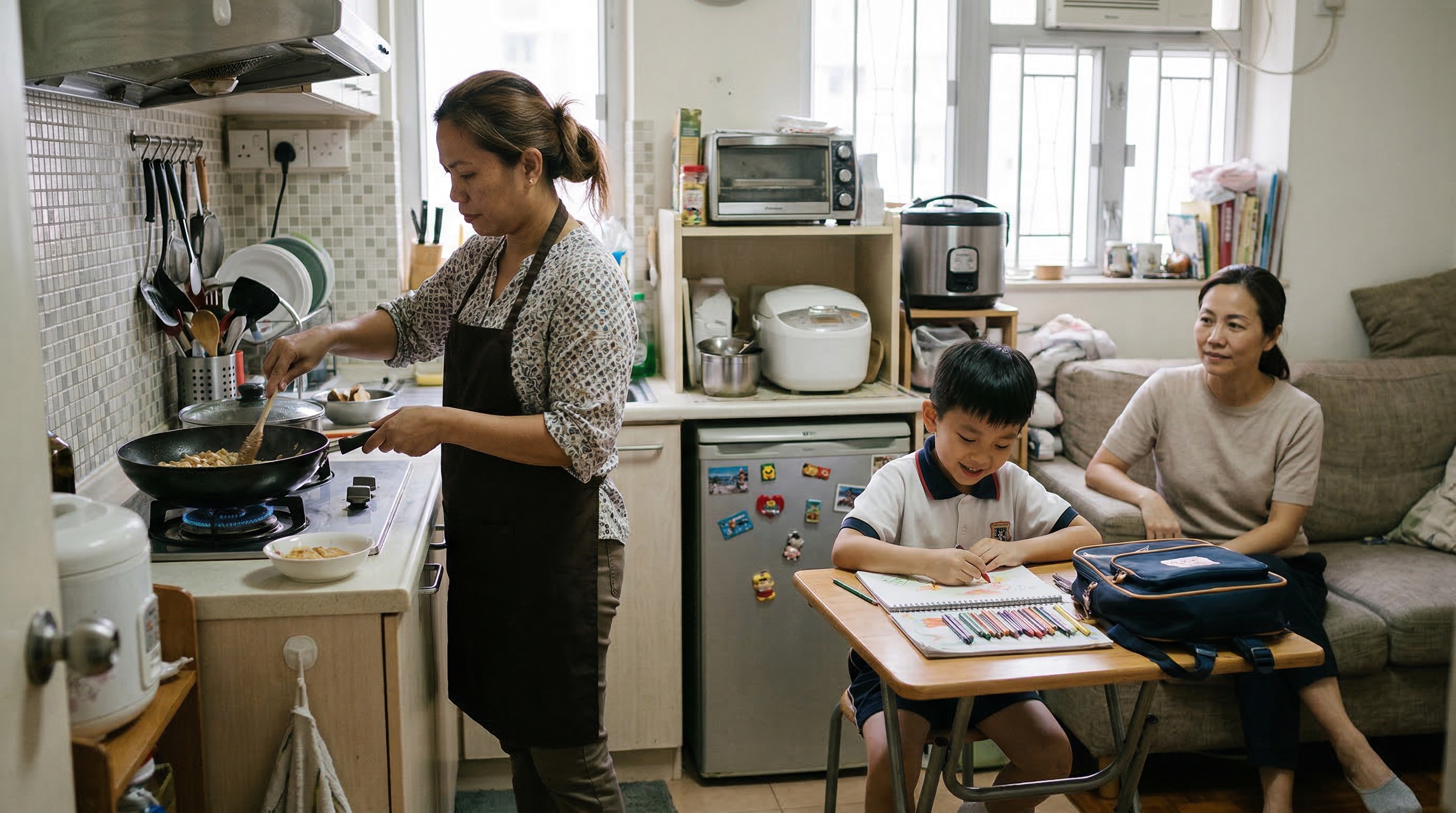
1. English Communication Skills
Filipino domestic helpers generally have stronger English skills. The Philippines uses English as an official language, and most Filipino helpers have received English-medium education from a young age. For families with school-age children, this is a real advantage — they can help with homework, read English storybooks, and practise conversational English daily.
Indonesian domestic helpers vary more widely in English ability. Those from urban areas like Jakarta or Surabaya often communicate well in English, while those from rural regions may struggle. If your household primarily communicates in Cantonese or Mandarin, English proficiency may be less of a deciding factor when choosing your helper.
2. Cooking Skills and Food Culture
Cantonese families typically want a domestic helper who can cook Cantonese dishes — and Indonesian helpers generally have an edge here. Indonesian cuisine has flavour profiles closer to Chinese home cooking: stir-fries, steamed fish, and soups are second nature to many of them. Some can even prepare traditional slow-cooked herbal soups, which elderly household members often appreciate.
Filipino domestic helpers can also learn Cantonese cooking, but may need more training time to adapt. If your family prefers Western-style meals or places less emphasis on cooking, Filipino helpers are fully capable. One important note: some Indonesian helpers are Muslim and will not handle pork — if your household regularly cooks pork dishes, confirm this before hiring.
3. Salary: Latest Statutory Minimum Allowable Wage (MAW)
With effect from 28 September 2024, the Labour Department has set the Minimum Allowable Wage (MAW) for all foreign domestic helpers at HK$5,100 per month — the same rate applies to both Filipino and Indonesian domestic helpers, eliminating any salary difference. From a cost perspective, there is no longer any difference between hiring a Filipino or Indonesian domestic helper.
Beyond the minimum wage, employers must also provide a food allowance (currently HK$1,236/month if meals are not provided in kind), labour insurance, MPF contributions, and agency fees. When all costs are factored in, the total difference between the two nationalities is minimal — salary alone should not be the deciding factor.
- Under the Standard Employment Contract (ID 407), both Indonesian and Filipino helpers are protected by the same Minimum Allowable Wage (MAW): HK$4,990/month (2024–2026).
- Source: HK Labour Department Standard Employment Contract and Immigration Department regulations.
| Category | Filipino Helper | Indonesian Helper |
|---|---|---|
| English Skills | Strong (official language) | Variable, depends on background |
| Cantonese Cooking | Needs training time | Generally adapts faster |
| Min. Monthly Wage (MAW) | HK$5,100 (from Sep 2024) | HK$5,100 (from Sep 2024) |
| Dietary Restrictions | Generally none | Some avoid pork (Muslim) |
| English Support for Kids | Clear advantage | Depends on individual |
| Elderly Care | Both capable, depends on experience | Both capable, depends on experience |
📊 DuckDuckDay Internal Placement Data (2024–2025):
• Filipino helper (local finished contract): avg. start date 3–5 weeks
• Indonesian helper (local finished contract): avg. start date 3–5 weeks
• Filipino helper (overseas application): avg. 10–14 weeks
• Indonesian helper (overseas application): avg. 8–12 weeks (up to 14–16 weeks around Eid al-Fitr)
Source: DuckDuckDay internal placement records (2024–2025, anonymised)
4. Childcare and Elderly Care
Both nationalities can excel at childcare and elderly care — it depends far more on the individual's personality and prior experience than nationality. During interviews, ask for specific examples of past childcare or elderly care situations. A genuinely experienced domestic helper will describe concrete scenarios, such as how they calmed a crying child or handled an elderly person's medical emergency.
Filipino domestic helpers' stronger English is a real asset for families whose children attend international or English-medium schools, and makes communicating complex instructions easier. Indonesian domestic helpers' cultural familiarity with Chinese food and domestic routines often means a shorter adjustment period in traditional multi-generational Cantonese households.
5. Stability, Personality and Reference Checks
Stability comes down to the individual rather than nationality. Whether a domestic helper will job-hop or leave suddenly is often tied to her financial situation, family pressures back home, and job satisfaction. We strongly recommend always requesting and verifying a reference letter from the previous employer — calling them directly is most reliable. Ask about her work attitude, communication, and attendance record.
Another practical tip: find out if your helper carries debt from fees paid to overseas recruitment agents. Heavy debt burdens create ongoing financial pressure that can affect performance and long-term stability. DuckDuckDay advocates transparent fee practices and helps employers understand a helper's financial situation before the interview, building a healthier long-term employment relationship.
Summary: There's no universal answer to Indonesian vs Filipino. Families with school-age children who value an English environment → Filipino domestic helpers may fit better. Families with elderly members, Cantonese cooking priorities, or multi-generational setups → Indonesian domestic helpers often integrate more smoothly. What matters most is individual interview performance and verified references. Contact a DuckDuckDay consultant — we match candidates to your specific family's needs.
Taikoo Shing Family: Switching from Filipino to Indonesian — Both Worked Well
A three-person family in Taikoo Shing hired a Filipino helper for their first placement, prioritising English conversation for their child. When the contract ended, they chose an Indonesian helper for their second hire, primarily for budget reasons. Both experiences were positive — but different: the Filipino helper actively conversed with the children in English; the Indonesian helper excelled at cooking and became a firm family favourite.
Consultant note: The choice isn't about which nationality is "better" — it's about which better fits your family's current priorities.